Destinations • Niue • August 2026
The most breathtaking little country that you’ve never heard of
We had not heard of Niue a few months earlier. We almost skipped it, and it became our favorite island so far. Most of a visit is on land: sea tracks, caves, and a limestone coast. Coming by boat, there are fifteen moorings, and Beveridge Reef is where we waited for one.

The island we almost skipped From Some Tuesday
We left Aitutaki on 20 August. Beveridge Reef is about 456 nautical miles from there, and Niue is about 130 more. Fifteen moorings, and our reservation was still a week away. The other choice was to sail past and go straight to Tonga. We picked up the ball on 28 August 2026. The week is in the log, and the exit from Aitutaki is in that one.
Beveridge Reef From Some Tuesday
This is the reasonable place to wait for a Niue mooring. No land in sight. Sixteen feet of sand on a submerged reef. The swell tops the reef at high tide, and about 16 hours of every 24 felt like a washing machine. About four calm hours, twice a day, at low tide. We were the only boat. I thought about scuba and decided not to. A dead outboard out there is a long way from help, so we stayed aboard.

We left on the afternoon of 27 August. The swell was nearly 4 meters at 8 seconds, from the southeast, and so was the wind, about 20 knots. Wing on wing, and the autopilot a little off dead downwind. Around 11 the next morning we doused the sails and motored in to Niue. Meghan took the helm to pick up the mooring in Niue. I stood on the starboard bow with a boat hook. The headsets are called the Marriage Saver. The passage is in the log.
Clearing in From Some Tuesday
Once we were on the mooring, I hailed Niue Radio. Customs was waiting on the dock. About ten minutes, then he stamped the passports on the hood of his car and said “Welcome to Niue!” The easiest clearance of the trip. The departure tax was NZ$350 total for the two of us: NZ$150 per person, plus an extra NZ$50 that I don’t remember exactly, but it was probably an inspection. We sent the arrival form in advance by email, to Immigration.Niue@gov.nu, the address printed on the form.
The crane, and a rental car From Some Tuesday

From Some Tuesday Make a dinghy lifting harness before you arrive. It’s a good project for the passage to Niue, because the dinghy is lifted out by the crane.
There is no fringe reef, and the harbor is open, so the dinghy comes up on a crane. Ours is over 700 pounds with the outboard. The small dolly could not move it. Friends on The Big Dog helped the first day. They have five kids aboard, three of them young men over 17. Keith, commodore of the Niue Yacht Club, arranged permission from Fisheries to leave the dinghy where the crane sets it. Meghan ran the crane after that. Two people can do it. We gave him a Some Tuesday ball cap.

The yacht club is run by friendly volunteers who are committed to making sure cruisers have an amazing visit to Niue. The log calls it the smallest yacht club in the world, and none of the members know how to sail. The sign on the wall says “The biggest, little yacht club in the world.”

Renting the car in Niue was a little more formal, since you’re required to get a Niue driver’s license to rent a car. But the casual trust still shows up. Everybody seemed quite comfortable that I didn’t have the license yet, and I would just stop by the police station to get the license within a day or two after renting the car. So, of course, I did. We used NIUE Rentals, on the main road in Alofi, a short walk north of the wharf.
When I arrived at the police station, the clerk had me fill out some paperwork but then asked if I could come back after lunch because the policeman was out on rounds. Yes, you heard that right. The policeman. As in one. For the island. Amazing.
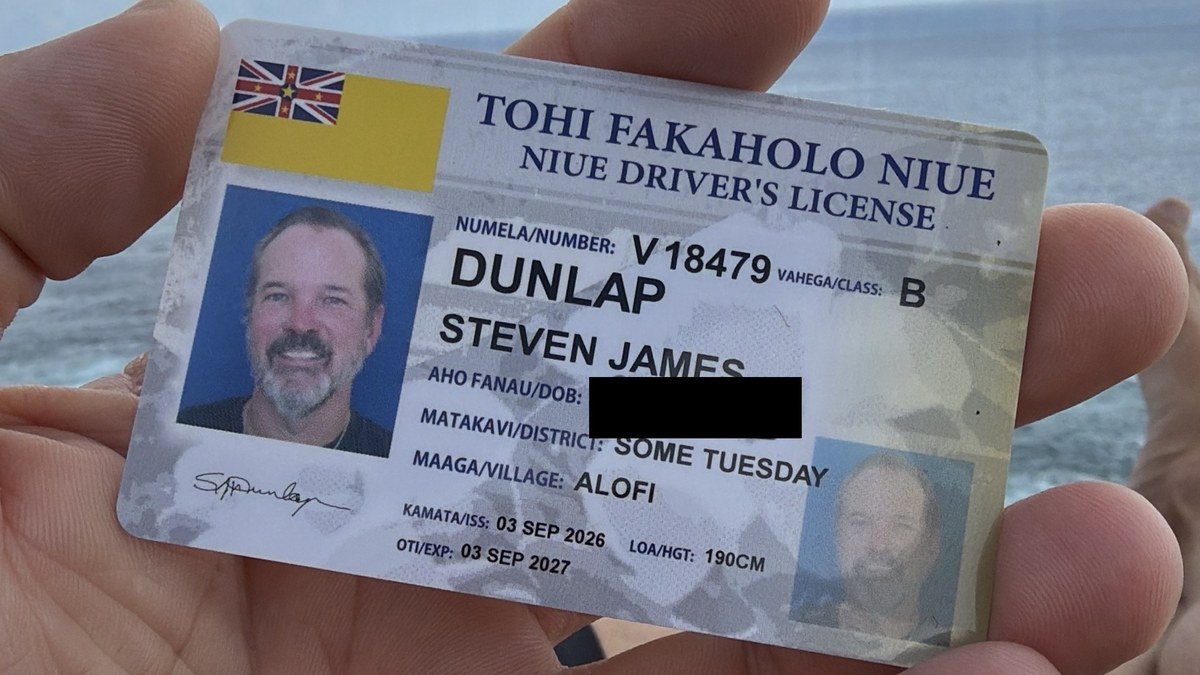
Drive on the left, which meant the wipers when I wanted the turn signal. People wave. If you stop to look at a map, someone stops to help.
Ashore From Some Tuesday
Limestone, and the high point is 68 meters. From the boat, Meghan said, “It’s flat as a pancake.” We drove the island over about three days and walked every sea track. Caves, stairs, ropes, and pools. One ladder was over 30 feet. The week ashore is in the log.


One sea track is a burial cave. The bones are right there in the open, protected by nothing but a rope, and treating them with complete respect is part of Niuean culture. The sign calls it Anaana, named for the grandmother, and says touching or disturbing the bones is forbidden.

Graves sit along the roads, about every 1,000 feet, and they are looked after. No outsider can buy land. Hio Cafe (say “hee-oh”) is run by Victoria. We had a long conversation with her when we had dinner at her restaurant. She explained that a tended grave shows the family still cares for that land, and she said, “We’re rich. Just look around at what we have.” About 1,400 people.

Hio does trivia night. Uga night needs a reservation. Uga is the coconut crab. Ours tore out of the sack, ran through the kitchen, and vanished into the woods. Her husband fetched another. The meat is nutty, from the coconut, and we liked the claws better. She told us to keep the hand supple and crack the shell with a spoon.

We went to church. The service was mostly in Niuean, with a little English. A restaurant meal was priced like Los Angeles. Trash cans sit at the sea tracks, even a long walk from the road, and I did not see litter. Wild chickens and roosters are everywhere, even more ubiquitous than the dogs. The mooring field had a waitlist, then we were the only boat, then it filled again. Next was a three-day passage to Tonga. The whales we were looking forward to are there, not here.

Heard from Cruisers
Most of this circulates by word of mouth among cruisers. We pulled it together, organized it, and share it free. It is not official guidance, so don’t rely on it as such.
What the yacht club page says Heard from Cruisers
From Some Tuesday We called Niue Radio, and every mooring has its own coordinates on the Yacht Club page, so coming in you know exactly where you’re going.
The Niue Yacht Club page puts the moorings on the west side, by the wharf at Alofi. Fifteen balls. NZ$30 a day, booked ahead, and the page publishes a coordinate for each one. It also marks some closed. Call Niue Radio on VHF 16 when you are in range, and do not come ashore until they say so. Check-in hours on that page are Monday 9 to 11, Tuesday to Friday 9 to 10 and 2 to 3, and weekends 3 to 4 by arrangement.
The same page lists clearance at NZ$50 per vessel, after-hours clearance at NZ$20, and a departure tax of NZ$150 per person. Free under 24 hours, and free under 12. Papers it names: the immigration small-craft form (email it to Immigration.Niue@gov.nu with the passport bio pages), the customs vessel report, and the biosecurity yacht form. It also names a health declaration. Visitors can’t fill it in ahead of time. They fill out the paper card on arrival. The do’s and don’ts are on the same site. Club email is nyc@niueisland.com.
A wreck on the reef Heard from Cruisers
A family on a catamaran wrecked at Beveridge Reef in 2017. Another boat already inside the reef rescued them. That is in the log. We were not there.
Questions
What is Niue like?
The most breathtaking little country that you’ve never heard of. Most of a visit is on land: sea tracks, caves, and a limestone coast. We had not heard of it a few months earlier, and it became our favorite island so far.
How do boats come ashore in Niue?
There is no beach landing and no dinghy dock. The crane lifts the dinghy out of the water, and it is stored on the wharf. Make the lifting harness on the passage, before you arrive.