Days 218 - 233 of our five-year circumnavigation (July 8 - July 23, 2026)
231 nautical miles sailed around these islands - they are very close to each other and short hops between them
8,400 nautical miles sailed since departing California on December 3, 2025
Lots of time spent in the dinghy exploring these gorgeous, lesser-known islands!
French Polynesia’s most famous island - Tahiti - gets all the attention. But the Leeward Islands are where the culture still lives at street level. Real villages. Real markets. A lagoon shared by two islands so you can dinghy across for a battery and be back before dark. We spent 15 magical days exploring Huahine, Taha’a, and Raiatea.
This is the stretch that came before Bora Bora. It was quieter, cheaper, and, in its own way, harder
Huahine
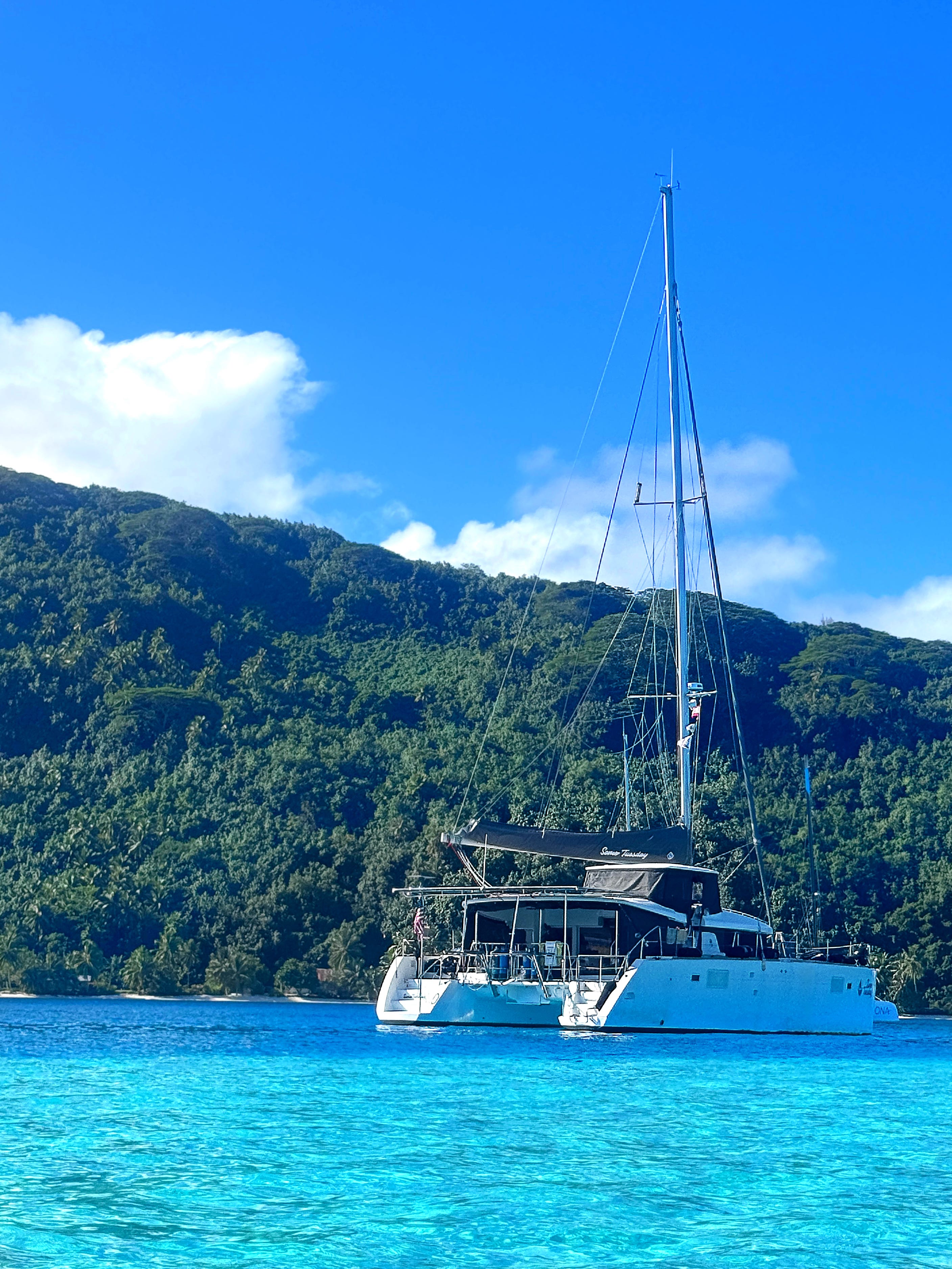
Our first anchorage was Avea Bay - a stunningly pristine bay on the SW corner of the island. We anchored in 10 feet - very shallow - in an attempt to float in the shallow turquoise water as much as possible! From our boat to the reef, nearly a mile away, was an open stretch of chest-deep gin-clear water, white sand, and plenty of blacktip sharks. As it turned out, I anchored a bit too close to this shallow water and when the wind shifted, Meghan quickly noticed that Some Tuesday didn’t feel right and was bumping along the sandy bottom! Yup, we had swung into shallow water and were soft-aground with both keels in the sand!
Luckily, she noticed right away and there was no damage, other than some light sanding of the bottom of the keels. I fired up the motors, easily pushed us back into deeper water and re-set the hook to keep us from swinging into the shallows again. You can see the shallow water in the photo below and Some Tuesday anchored just over the dark-blue line indicating deeper water (about 18 feet).
We visited the Hotel Le Mahana Huahine by dinghy several times with cruising friends, including Dave and Dani from Sailing Solis. Meghan and Danielle spent nearly a full day lounging in the “pool” as I pulled them around the bay in the dinghy!
Just so you know it’s not all sunshine and rainbows out here, also know that I spent two full days sitting on that same “pool” and scrubbing green tropical goo off the waterline. It grows quickly in the tropics and it can be hard to keep up with. I then spent two more days with scuba gear, a scraper and a scrubber cleaning barnacles from below the waterline. Satisfying, but not fun!
Next we moved on to Fare, the largest town on the island and spent several days there provisioning, cleaning the boat and generally putting things back together. The shops there had decent supplies, and Meghan has made herself into provisioning guru. But it’s a never-ending job.
From Fare, we sailed outside the reef and around the top of the island into Maroe Bay, then worked our way south through a complex “channel” with plenty of room for dangerous mistakes until we found the mooring field at Motu Muhimaroa. This bay had no protection from the southerly wind, which was whipping at 28 knots, but we didn’t mind because the water was smooth as glass, given the protection from the reef.
This was a special place because few sailors - and no charter customers - ever seem to find it! We were alone for four days, as the other moorings drifted aimlessly. And yet, it was beautiful, serene and smooth!
This was the first place we picked up a mooring ball, which required swapping our usual assignments and for Meghan to take the helm. To pick up a ball, I have to stand on the bow with a boathook to grab a line that is attached to a buoy floating in the water. The buoy itself is attached to a concrete block on the ocean floor. Once you’ve picked up the line, run your dock lines through the eye, and you’re moored. It’s similar to anchoring, but more permanent and common in crowded destinations like Bora Bora.
The work on the bow is physical, and not worth risking the artificial disks in Meghan’s spine - the reason for the swap. On the helm, her job is to put me right on top of that buoy and time it right so the boat will stop right there with a quick blast astern. It requires “touch” on the throttles and the rudders and yet, she nailed it on her very first try as I grabbed the line easily. Attagirl!! We shared a celebratory high five and she mixed up some Dark & Stormies.
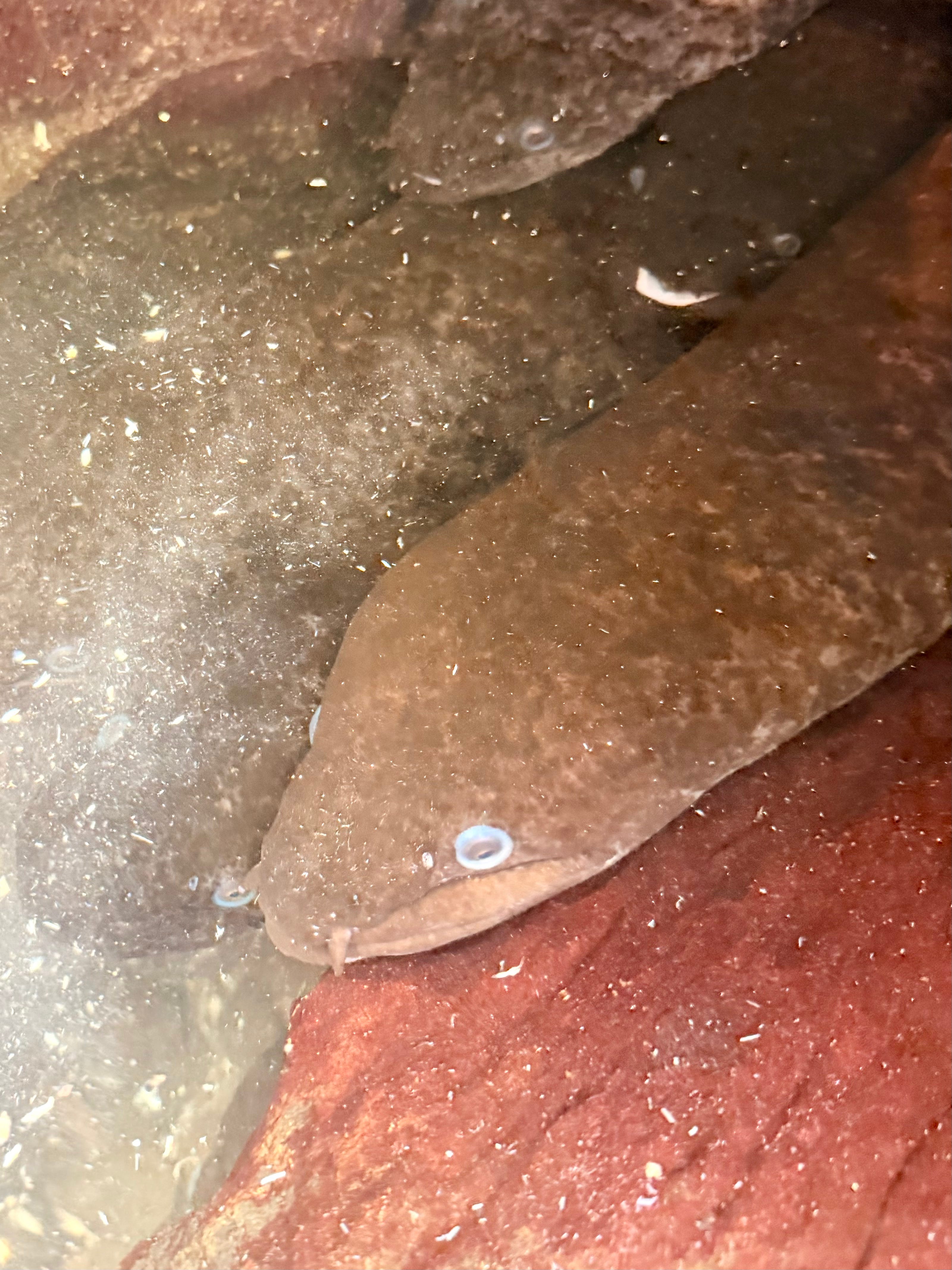
We used Muhimaroa as a home base for several days and took the dinghy out to tour the entire island. We ran all the way up to the next bay to the north — Baie de Faie — where the sacred eels live.
On the way there, the water gets very shallow and treacherous - even for a 12 foot dinghy that drafts only about 10 inches with the motor tilted up. We grounded on coral twice. Both times I had to climb out, lift the motor all the way up, and walk the dinghy around to deeper water. That is part of the story of these islands. They are raw and rustic and not well marked. You pick your way along and do the best you can. Sometimes things go wrong, and you find yourself standing in waist-high water pulling the dinghy by hand.
The eels themselves were really cool. They are the puhi tari’a — Polynesian long-finned eels that can reach two meters long, with those striking blue eyes. They are considered sacred and tied to legends of Princess Hina. When we arrived, a local guy was hanging out at the spot, feeding mackerel so the eels would come out and show themselves. He counts on visitors giving him a few francs as a tip. We tied up at a small dock and walked a couple of hundred meters into the village. A genuinely cool experience.
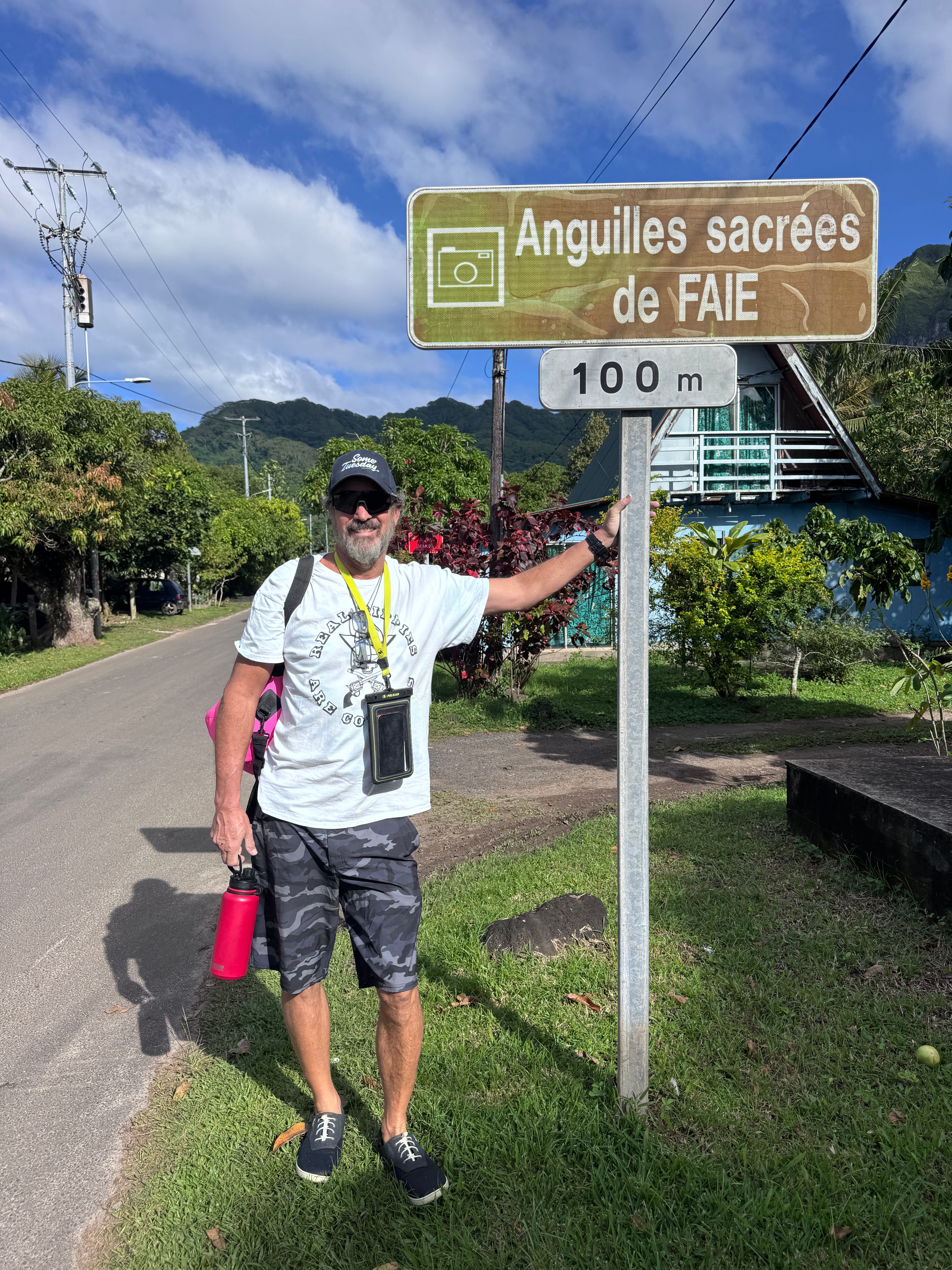
Huahine is two islands connected by a bridge — Huahine Nui and Huahine Iti — and it still feels like a working island more than a resort. Grounding the dinghy demonstrates the rawness of the place. It is the uncharted side of the Societies that makes feel very different and somehow more authentic from the postcard islands farther west.
On that same dinghy tour, I was very excited as we buzzed by what I was sure was a floating bar! As we approached, based on the looks, I became less certain about it being a place to grab a cold beer, and waved a friendly hello to the folks sitting outside. “Ia orana, my friends! Is this a bar?,” I asked, trying to be as charming as possible. “No,” they smiled, “It’s our home!” We still laugh about that one today!!
West to Taha’a
From Huahine we sailed west to Taha’a, the vanilla island on the north side of Raiatea. Taha’a produces most of French Polynesia’s vanilla, and the air around the bays can carry that scent. We spent a couple of days cruising around the island and anchored in a couple of spots.
On the way there I caught a 43-inch yellowfin tuna. That was the biggest fish I had ever caught at that time. I have gotten pretty good at filleting them and cutting the meat off clean. That took practice and some YouTube videos.
Taha’a and Raiatea sit inside the same fringe reef. There is a big stretch of calm water between the two islands — calm enough that you can take the dinghy back and forth. That turned out to be handy.
The generator, Richard, and the rough dinghy ride
On Taha’a we had problems with the generator. I found a fellow named Richard, contacted him on WhatsApp, and hired him to help fix the generator and replace the battery. He said, hey man, if you can meet me at the marina at Raiatea in an hour, I’ll drive you over there to buy the battery, and then I’ll come work on the generator the next day.
I hopped in the dinghy and rode across the rough water between Taha’a and Raiatea — rough for a 12-foot dinghy, anyway — getting sprayed the whole way as I bounced off the waves! My choice was to get wet or take over an hour to get there. I chose wet. Soon enough, I tied up at the marina, hopped in his personal car, bought the battery, and he drove me back. He recommended a public dock we could use in Raiatea to eliminate the dinghy ride and enable walking to the local chandleries and hardware stores. Then he met us there the next few days, got the generator running and installed new electrical circuits for our now significant collection of electric appliances in the galley. Really great service.
The nice thing was that as we worked together, it reminded me of working with my dad. He was knowledgable, resourceful and patient - the kind of guy that can fix anything with duct tape and baling wire. He was teaching the whole time, and I was sponging up the knowledge. We ate lunch together and talked about life. I learned everything from how to remove the starter motor from the generator to how to clean the glow plugs. We even got into philosophical discussions about faith, since he is of the Baha’i Faith, and I’d never heard of it. He brought me up to speed, and it was a fascinating discussion - but I’m still Team Jesus!! ✝️
Raiatea also gave lots of opportunity for re-provisioning. Uturoa provides a short walk to Carrefour and other shops. Carrefour is often referred to as “French Wal-Mart” and offers the luxury of being able to find most things you might need - and some you didn’t know you needed! They even had an “America Aisle,” marked with a huge red white and blue, old-glory themed banner and stocked full of American products! We spent several days shopping and getting the boat tuned up again. After months of thin shelves on smaller islands, that felt like a real break.
The vanilla farm that did not want us
At one point we cruised into one of the vanilla farms. They had a number of moorings out there. We started to pick one up, and within a few minutes the old man who owns the farm had run down from his house, jumped into his dinghy, and zoomed over to tell us we could not stay.
We tried to explain that we were interested in taking a tour of the farm and would be happy to pay for the mooring and the tour. He was not particularly rude. He was also not interested in our business or our tourism. He just wanted to get rid of us.
There were five moorings. None of them were in use. He made it very clear that the people who lived there did not want anyone moored out there, and that even if he had given permission, we would not be allowed to play the radio or run the generator. They just did not want anybody there.
Some farm families genuinely want their stretch of lagoon to stay quiet and exclusive. That is their call to make, and we respect it! We “read the room,” dropped the mooring and moved on.
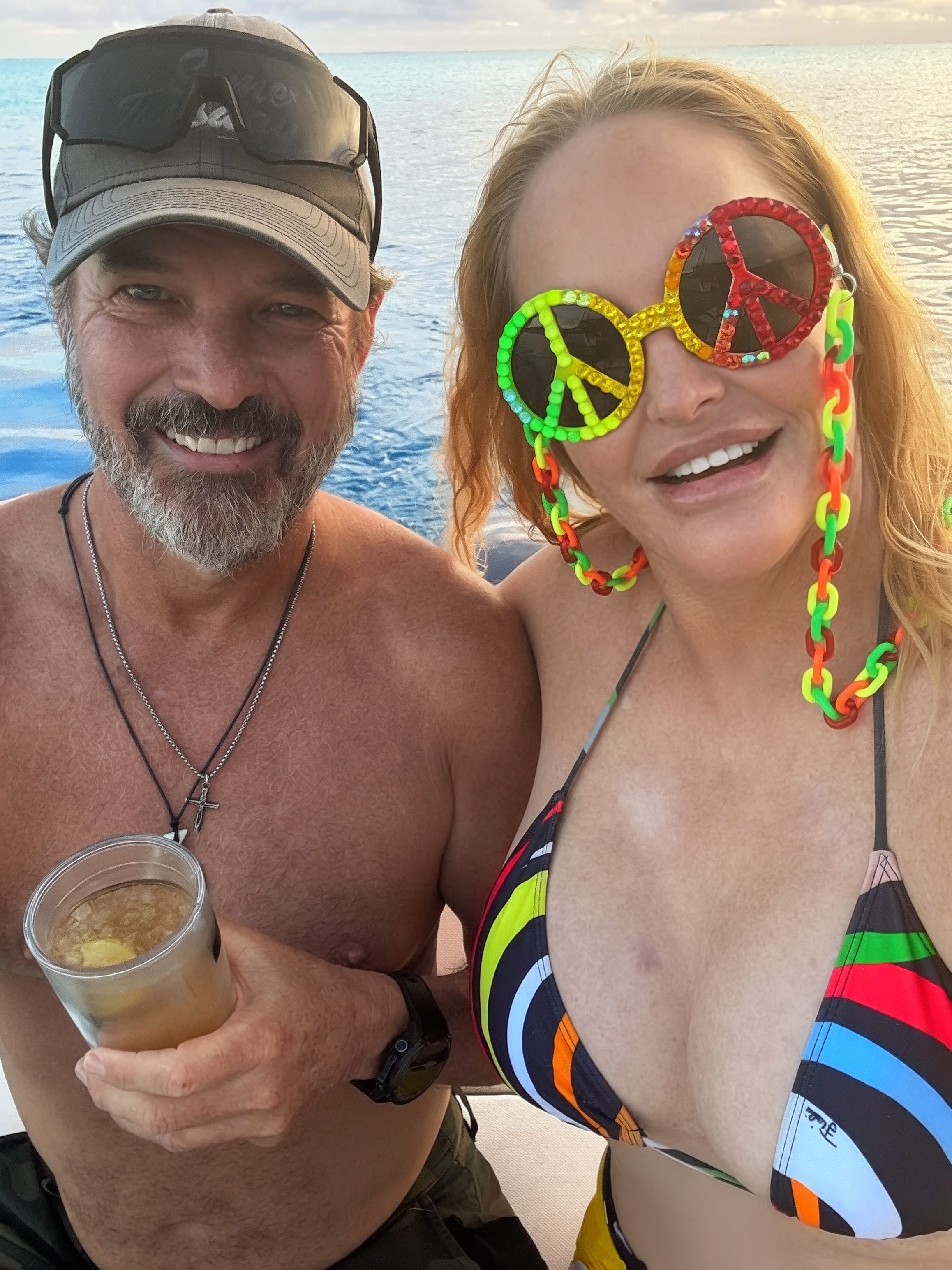
By the time we left Taha’a and Raiatea it was July 23. We had arrived in French Polynesia on May 1 with a 90-day visa that ran through July 31. The boat was in good shape. The lockers were full. We exited the pass and headed for Bora Bora.
Bora Bora would not disappoint.