Key Info of our Five-Year Circumnavigation
147 Days since departure from Marina Del Rey, California on December 3, 2025 to today, April 29, 2026
28 days at sea, to cross the Pacific, since departing El Salvador April 2, 2026
6,735 nautical miles sailed since departure (including 3,763 to cross the Pacific)
Four countries visited (US, Mexico, El Salvador, French Polynesia)
5.5 months into a planned five-year circumnavigation
Next destinations: Cook Islands, Samoan Islands, Tonga, and then Fiji by November
Two mainsail battens broken, one prop wrapped, one grounding, one injured elbow, and one girl recovering from spinal surgery!!!
Three fish caught (two blackfin tuna and one yellowtail)
Dedication
First, a quick tribute to my friend of over 25 years, Shane Chalke, who may be the most dedicated reader of this Captain’s Log! I had fallen out of practice keeping the log up, and he added his voice to Meghan’s, encouraging me to keep writing! He also suggested that having the feature to get an email when a new post appears would be great and would help attract more readers.
Based on his urging, I did some research and quickly found Substack would be the easiest to use and offers all the extra features to support a “real” blog. I can now embed photos and videos, for example. I think this will be a nice upgrade, and I want to applaud Shane for his urging me along. I’m humbled and honored that you guys like my writing, and as long as you keep reading, I’ll keep writing!
Now, onto my very first Substack article, the Captain’s Log Entry for today, Arrival Day, April 29, 2026 - one of the most memorable days of our lives!! (I’ll copy the old ones over here in due time.)
Ocean Tactics Weather Routing
As I always do, I include the comms with John Martin of Ocean Tactics. He’s our “weather router,” a meteorologist and experienced sailor who watches the weather (from New Zealand) and gives us ongoing daily advice about routing to take best advantage of wind and current. He also monitors our position to help us avoid storms and danger, and often gives me sailing advice that is helpful to life on board. He’s a great guy and very helpful. He’s forgotten more about sailing than I’ll ever know, so he’s a very valuable resource!
OT:
How did you get on with your local guy for info??
I have you less than 60nm to run.
Expect 18-20 with gusts to mid 20’s in an unstable flow.
Thunderstorms and lightning, 60nm to the north of you moving NW to SE should pass behind you. Expect a slight moderation in conditions as you approach Nuku Hiva
Me:
Copy that - thank you! And yes, local guy confirms harbor is open and well marked, easy to enter at night. Advice is stay to north side and slowly motor until depth 45 feet or so, then anchor. That will avoid other boats because everyone else is farther in. Then, I’ll move in the morning when I can see.
Weather is good enough - compared to yesterday!!
I’ve got a line caught under the boat. Sheesh. Always something. I was advised to drag lines along the side of the hull to knock barnacles off. One of them is now caught in something, maybe the folding prop. If I can’t work it loose, I’ll have to find a clear spot somewhere, probably in the lee of Ua Huka, and go for a swim!
I want to thank you for this passage! You have been delightful to work with. Thanks for keeping us moving and safe!!!
OT:
Maybe better to leave it and come in on one engine???
Me:
I can’t maneuver safely at low speed on one screw
OT:
Anyway, not over yet, send me a note when you’re safely anchored
Me:
Absolutely
Land Ho!!!!!!!!!!!
Update: sails down, ducking into an anchorage to drop the hook while I fix this. Feels way safer! And I’m sure the authorities will understand. I’m not interested in coming into Nuku Hiva in the dark on one prop!! 🤷🏻♂️
OT:
Let me know how it goes:-)
Me:
Total success. You can see where we anchored. It was bizarrely wrapped around the sail drive, not the prop and wedged in the shroud around the drive. It was easy to dislodge but needed to be pulled straight down. Impossible unless you’re under the boat!
On our way now. But we are so damn sick of these huge angry seas. Did we get unlucky on our crossing? I don’t think this torture is normal, is it???
OT:
We were doing just fine for the first 3/4 of the passage but the last high intensified dramatically and the tropical disturbance along 6-7S just complicated matters;-(
Not usual and left us with very few options!
Me:
Ok. I was feeling like we got worse weather than most. You’re saying that’s the usual??
OT:
No, NOT usual! Unfortunately once you’re past Galapagos you have few choices but to take what you get! The diurnal effect also is most unusual and the seastate significantly shorter period than the winds would have usually created
Yes, a centre pressure of 1040 on the high is most unusual that far east
The name Pacific comes from the word Passive. It was anything but!!!
Captain’s Log, April 29, 2026
There is a lot of emotion involved in a passage like this. We shot this video the day before arrival day, after I had calculated that we only had one more night at sea.
The day started pretty normally enough. Night watch had been routine. Meghan gave me four straight hours of sleep, which felt luxurious. Exhaustion was setting in, after four weeks of never sleeping more than 3 to 4 hours at a time. Meghan sat night watch from midnight until 4am. I came back up at 4 and stayed on until she got up to make coffee around 7:30.
Once she was up, I grabbed another 90 minutes of sleep before I got up to start preparing for arrival. Based on my calculations, I expected to be yelling “Land Ho” perhaps as early as 8 or 9am. But, the horizon was so hazy it quickly became obvious that wasn’t going to happen. We researched the islands and learned that Hiva Oa, to the south, had the highest elevation with a tall volcano, so we expected to sight that first.
Instead, at 11:30am, the shadowy outlines of the tiny island of Ua Huka began to take shape. That island was directly in our path to Nuku Hiva, so it made sense. We spotted it approximately 20 miles out, and after I spent a minute or two making sure my eyes and the horizon weren’t playing tricks on me, I confidently started shouting, “Land Hooooooooo!!! Land Hoooooo!!!”
It’s almost impossible to describe the elation and the electricity in the air as we danced around, shouting “Land Hoooooo!” 28 days at sea, without seeing other human beings, no civilization, nothing other than blue ocean as far as the eye can see is really quite an experience and all that isolation bubbled up and came spouting out of us as if from a bottle of champagne!!
Of course, there’s always a problem to deal with and today was no different. I had been working my way around the boat that morning, preparing for coming back into a harbor but re-stowing gear that was on deck, tidying up, battening down, etc. For most of the passage, we had been trailing long lines (ropes) from the bow in order to knock barnacles off the hull and prevent as much growth as we could. This was advice I had gotten from our good friends at Ocean Posse, and it was good advice and worked well. The lines were tied to the bow, and ran along the hull at the waterline. The up and down motion of the boat in the ocean rubbed the lines along the hull and effectively scrubbed off all the barnacles for several inches below the waterline. It was great!
I reeled in the port side line with no trouble, coiled it up and stowed it away. But when I began reeling the starboard line, it wouldn’t budge. It was securely wrapped around something below the water line, and would not come loose. It could be around the rudder, or the sail drive and propeller assembly - I couldn’t tell. But it was definitely not coming loose. I tried pulling on it from both sides of the hull. Then I grabbed a piece of it near the stern, untied it from the bow and dropped it in the water so it could stream aft. I secured one end to a cleat and let the loop drag in the water for several hours, hoping that might dislodge the line. Negative. It was not coming loose.
This means that motoring with the starboard engine would not be possible until I solved this problem! Turning the prop would simply wrap the line around it, causing untold damage. That’s critical because catamarans maneuver at low speed using the twin props, more than steering. For example, if you position the throttles to port-forward and starboard-reverse, the boat will spin clockwise within its own footprint. It’s a big boat, but VERY maneuverable. But not without a starboard prop!
I spent much of the day planning how to solve this problem. I had decided to sail into the lee of Ua Huka, then heave-to (a method to make the boat sit still in the water, as much as possible) and then grab a dive mask and dive under the boat to fix it. It was obvious to me that the only way this was going to be fixed was with me, in the water, with a dive mask and maybe a sharp knife. I had tried everything I could from up on deck.
As we got closer, and the strong currents and winds refused to die down, I started to become concerned that it would be very unsafe and perhaps impossible to work underneath the boat in those conditions. So I had two options: try to motor into Taiohae Bay on Nuku Hiva, in the dark, surrounded by volcanic rock and expensive boats, with only one working prop…. Or…. Find some way to anchor while we still had daylight and I could safely get to work. The latter option was the obvious choice.
I identified on the chart a small bay named Hane, on the island of Ua Huka and decided to anchor there, just long enough to fix the problem. But now we had a new concern: the authorities in French Polynesia strictly prohibit visiting any other location until you’ve been cleared at a Port of Entry, which are only on Nuku Hiva or Hiva Oa. So technically, I’d be breaking the law by dropping my anchor when I was not approved to be in the country yet.
Meghan was particularly concerned about this, as she had read a lot of posts that talked about how important it was to observe this rule, and also since we had dogs and plants on board, we were doubly concerned. She suggested we contact the agent we had hired to help us clear customs, Kevin Ellis. He said he was confident the authorities would understand, given the danger of the situation. So we set a course to Hane Bay!
As we approach, I saw a vessel named Wildmaa already anchored there and hailed him on the radio to ask about the conditions. He told me it was a bit rolly and a relatively small anchorage, but it was fine and there were no other boats at the moment. Good enough.
As we approached the bay however, it appeared to be downright tiny!! We had to skirt by an enormous volcanic outcropping to our starboard and sneak into the bay, to get behind an artificial breakwater. Meghan and I sat together at the helm, assessing the situation, while all our “Crew” on the livestream watched with bated breath! Our confidence was not high, and it looked sketchy to me. So I called off the approach and circled around. Remember, I was maneuvering on a single prop so I could only turn in VERY wide circles. If I got into that bay, and wasn’t able to get the anchor down safely, the chances I could get caught in a situation I was unable to maneuver safely out of were non-zero. Not insurmountable, but the risk of disaster was NOT zero.
As I circled, I weighed my options and Meghan and I discussed. The options were, sail around all night so I could enter Taiohae in daylight, still with restricted ability to maneuver, OR go swimming without anchoring, OR try the Taiohae approach in the dark, OR… suck it up and try to get the anchor down in this bay. That’s the approach we decided on. I came in, circled wide, and then aborted the first attempt because we were too close to the rocks. Circled again, positioned as best as possible in the lee of that huge rock outcropping and… hit the “down” button on the windlass. 65 feet of water. 200 feet of anchor chain. And soon enough, we were swinging safely and taking measurements with my laser rangefinder to the nearby rocks and breakwater.
By monitoring those exact measurements, I can tell whether the anchor is dragging or the boat is moving excessively. Finally, I was comfortable that we were safe from swinging into rocks, and grabbed my dive mask. I jumped in the water, knife in hand and ready to get to work. I prayed it would be easy and quick and that I would not need scuba gear. And sure enough, once under the boat, I found the line stuck between the sail drive and the plastic cover/surround.
I gave it a swift yank straight down and it came right out. The whole reason it was stuck is that, from above, it was only possible to pull sideways, which was held tightly in place by the friction. Once I could pull straight down, it came free instantly. I was back on the surface within 45 seconds, and Meghan was thrilled and surprised when I announced “Problem solved!” Excellent!!!
Now, crisis was averted and we could enjoy ourselves. We had been on anchor for less than an hour, but the hook was holding and I’d gotten comfortable with our position. So I proposed to Meghan that we shift our planned Arrival celebration from Nuku Hiva to here at Ua Huka, since we were officially in French Polynesia, even though it was just a touch illegally!! Still, celebrating at midnight, in the dark, in Nuku Hiva paled in comparison to a toast and popping champagne right here in this beautiful cove. So we decided to stay another hour, have our little celebration (with all our friends and crew on the livestream, too) and THEN weigh anchor and continue on our way to a nighttime arrival to Taiohae.
As if to confirm the wisdom of our decision, several huge manta rays swam by the boat at this moment. Wingspan was easily 15 feet on the biggest of the three, and we felt like they were saying, “Yes! Of course! Pop the champagne right here!” How could we say no to these majestic, graceful creatures, welcoming us to French Polynesia?
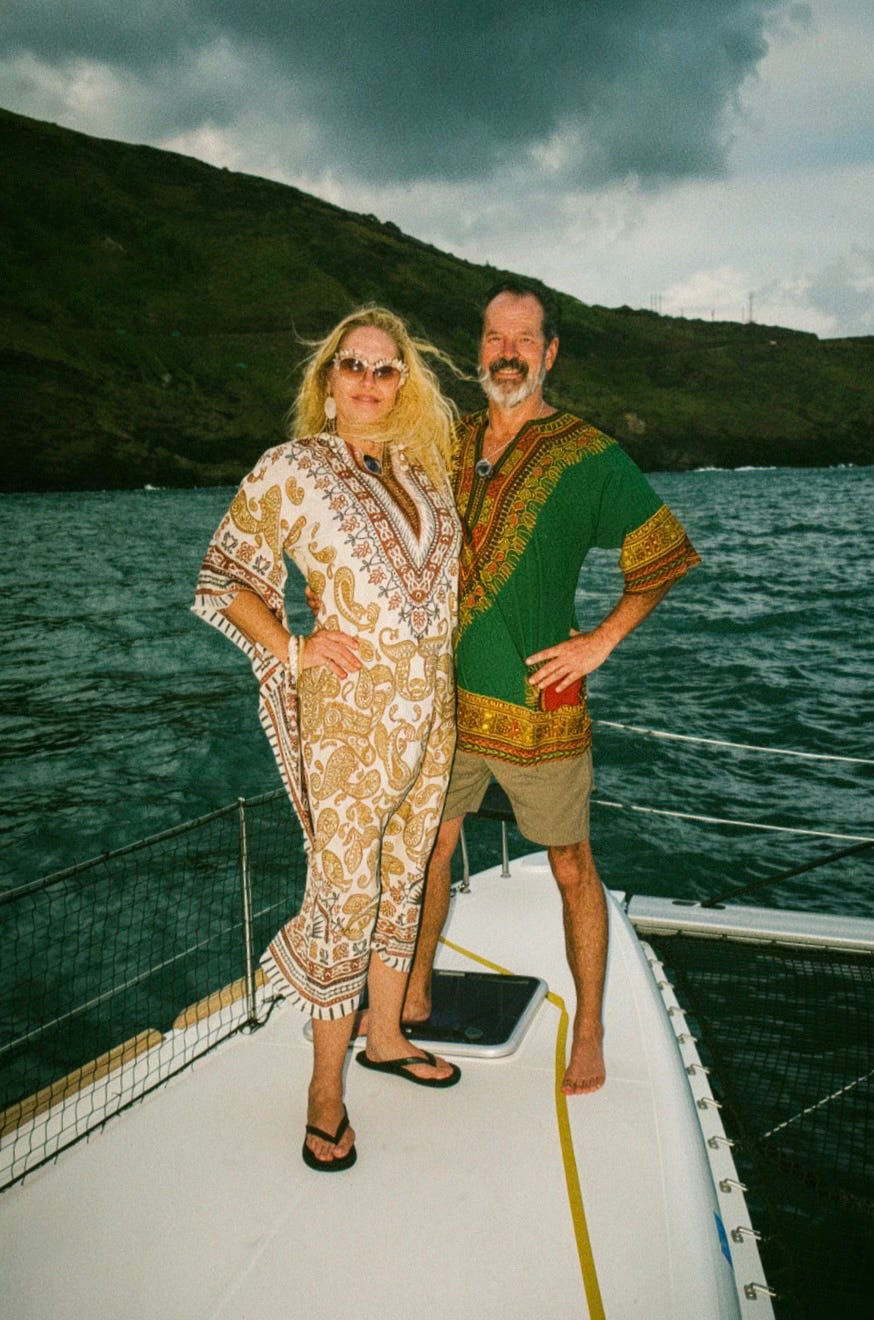
We went up to the bow and properly celebrated with a few words, again sharing with all our friends and Crew on the livestream. We popped a bottle of Vueve that Meghan had been saving for this occasion and cracked a couple of Some Tuesday Lagers to round it out. With toasts and cheers all around, it was official! We had spent 28 days at sea and successfully made landfall in French Polynesia - just not on the island we had planned!!
It was time to press on, so we weighed anchor and motored back out of the bay and into the very angry Pacific Ocean. As you can see from the comms with Ocean Tactics, we had been subjected to VERY unusual, brutal weather for the final 11 LONG days of our passage. An unexpected high pressure system had settled in and subjected us to 11 days of 25 knot winds and 12-15 foot seas on our aft port quarter. The wind and waves were bad enough, but the quartering sea? That ensured that our poor boat was pitching AND rolling, endlessly, like a mixing bowl. For. Eleven. Full. Days.
Now, I don’t get seasick. I just got lucky with genetics, I suppose. But I’ve literally never been seasick and rough seas don’t bother me. But I found myself sitting down, head-in-hands, and just begging God to give me a rest from this torture. Just take a moment and try to imagine 11 straight days of up-and-down-and-side-to-side-sloshing-and-yawing-and-surfing along waves that are nearly two stories high. 11 days. 264 hours. Never ending. No breaks. All you can do is… endure.
And there I was, wondering if we were just weenies and complaining more than we should be allowed about how tough our crossing was. But no. John is an old salt with dozens of ocean crossings under his keel. He’s forgotten more about sailing than I’ll ever know. And he confirmed it. We got hammered. But good. So, I think it’s fair to say we’ve earned our stripes!
The brief respite in Hane Bay had given relief from this mixing bowl, but now as we motored out and immediately took 12 footers on the beam, we were reminded of our fate. We still had 33 nautical miles to go, and would have to enter Taiohae Harbor in darkness, knowing nothing about the local waters, feeling our way to a safe anchorage among at least 40 other boats. Lovely.
Within an hour or so, we were able to turn to the west, toward Nuku Hiva which put the seas back behind us, on our aft quarter. It was less awful, and we were used to it. We took a breath and mentally prepared for the last five hours of our Pacific Passage.
Just before midnight, we were motoring along the south coast of Nuku Hiva, and could see almost nothing in the sparse moonlight. Outlines of the coastline. Some large cliffs. A glint here and there. But no lights. No signs of life. Only the charts to tell us that the island was only 1.5 nautical miles to starboard.
As we rounded Mataupuna, the enormous rock on the east side of the entrance of Taiohae Bay, the lights came blazing into view. Houses and buildings. Boats. Navigation beacons. Commercial piers. Signs of life!! It was a small coastal town, but after weeks of nothing but blackness, it looked to us like Las Vegas! Bright and lively. And meant civilization. And maybe a restaurant meal (we would be disappointed, but that’s another story.)
Around midnight, we rounded Mataupuna and headed directly into the harbor. Per the advice I’d received, we skirted the north side, keeping well away from the commercial docks and no-anchor zone. We felt our way along in the dark until the depth sounder told us we were in 45 feet of water. That’s the advice I’d received - stop here and anchor. Everybody else is shallower, so you know you’ll have plenty of room. We can move in the morning.
We dropped the anchor. Cautiously eyed some rocks that were awash just a few hundred feet away (and decided we were safe). Meghan went to bed, but I stayed up for another couple hours. I just can’t sleep until I’m 100% certain the anchor is well set and hasn’t dragged. So, I went up to my favorite spot on the bow and stared at the stars. Meghan was fast asleep by now, and I sat alone. Contemplating.
We had just sailed across the largest ocean on the planet. Alone. Over 28 days, 11 of which were pure hell. We dealt with problems, broken equipment, dashed morale, emotions, and various other problems. But we freakin’ did it. We planned to do this YEARS ago. We dreamed about it for years. We told our friends over and over we were going to do it. It was hard as hell. And it was glorious.
It’s the most difficult, wondrous, coolest, most satisfying, most sublime thing I’ve ever done in my entire life. And Meghan and I did it together. She is an incredible partner and first mate, and made sure we ate like kings during this adventure. Together, we did something most people will never even dream of, much less embark upon.
We sailed across the Pacific Ocean.