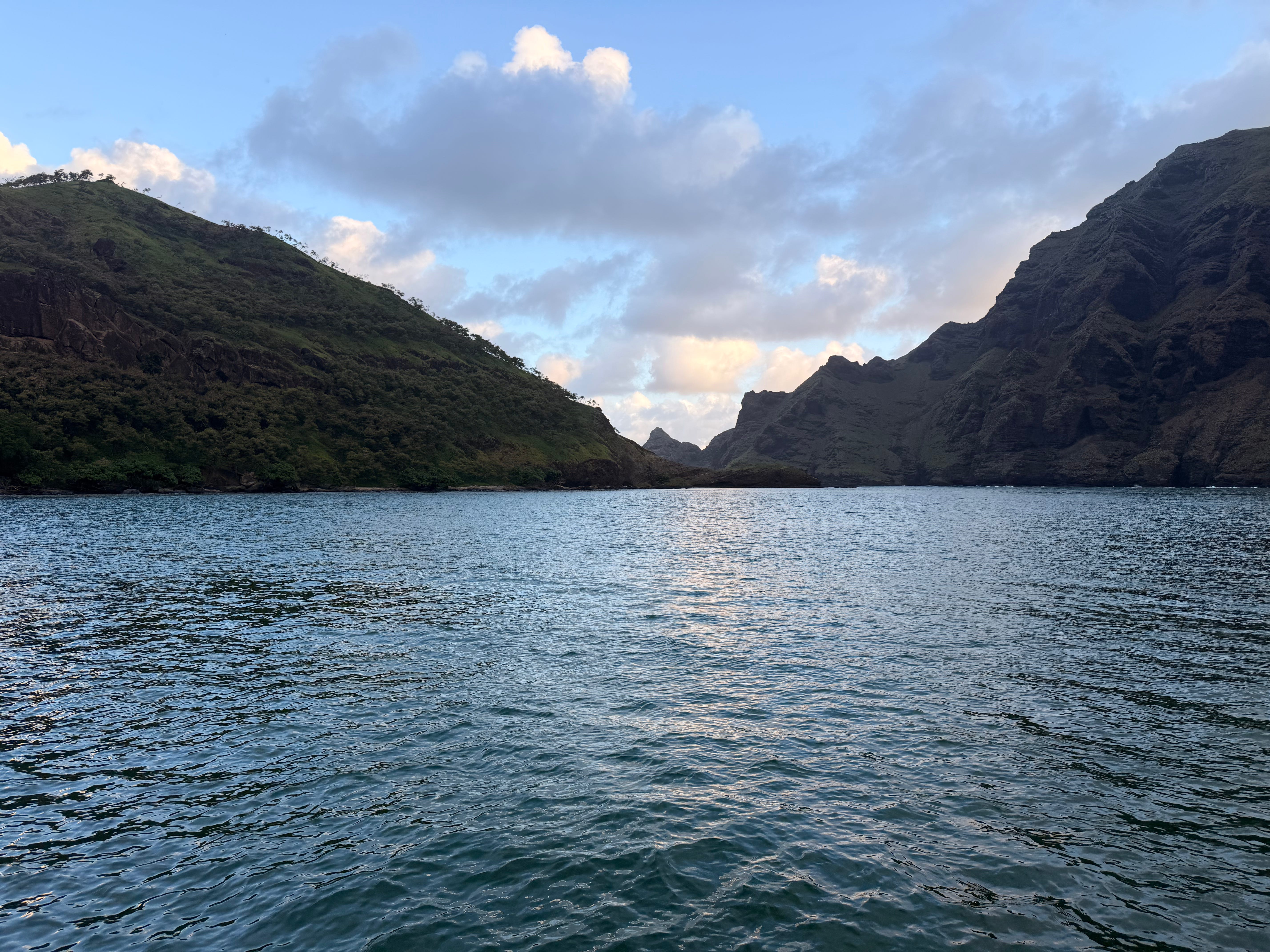
Key Info
We arrived in Nuku Hiva near midnight on April 29, 2026 after 28 days at sea crossing the Pacific
6,741 cumulative nautical miles sailed (including 3,763 crossing the Pacific)
Took on 862 liters of diesel fuel at a cost of about $1,648
Multiple provisioning trips, estimated cost of $800
Taiohae Bay, April 29 - May 5, 2026
After anchoring near midnight and staying up until nearly 2am ensuring the anchor was set, neither one of us slept well, nor long. We thought we would sleep for 16 hours straight, and boy were we wrong. Our bodies had acclimated to only sleeping 3-4 hours per night, with short naps throughout the day. So we were both awake early the next morning - unable to sleep longer, and quite crabby about it! We were exhausted and totally spent from our long Pacific passage.
We didn’t do much the first few days, and after the elation of the crossing died down, we were not in great spirits. We didn’t want to be negative, but all we wanted after a month at sea was flat water, a nice restaurant meal and clean laundry. None of those came to be.
Before any of that could even be attempted however, we had to deal with the rain. It rained every day. Multiple times. And when you’re living on a boat, you can’t just go inside. Our cushions were wet, laundry was damp and nothing ever fully dried out. Things were beginning to smell musty and we were very concerned that would become permanent. It would be five full days before we got a day without rain, and even then it was cloudy all day.
Cloudy means more problems, because the boat runs on solar panels. No sun means no electricity, which means running the generator and burning diesel. The upside to that is that we try to run it at night if needed, which then gives us the ability to run the air conditioning. When you live on a boat, you learn to carefully manage things you never thing about when living on land. Electricity usage is a constant trade-off. Do we run the ice maker, or are the batteries too low?
Water is another one. We only run the water maker when we’re at sea or a pristine anchorage. Running it in a harbor, most of which are polluted with diesel, oil and sewage, even in small amounts, may ruin your filtration membranes. And besides, who wants to make water when the next boat over might have their blackwater tanks open? Yuck. So, we strive to arrive at every anchorage with full water tanks and that water must last until it’s time to leave. Local water is usually not an option, and typically not potable anyway.
Poor Meghan desperately wanted a nice restaurant meal. So did I, but I really wanted her to get what she wanted: fresh veggies, maybe some chicken…. Alas, we quickly learned there were only 2 or 3 restaurants in Taiohae, and their hours were unpredictable. Restaurants there close between mealtimes, so if you want lunch at 3pm, you’re out of luck. And as luck would have it, that was exactly when we went ashore for the first time! We ended up dejected, after walking all over town, and slunk back to the boat to heat up some canned chili.
Laundry? Nope. The local service told us they were already full-up and besides, it was a holiday. By the time they could take our laundry, we planned to leave.
Flat water? Taiohae is directly open to the swell coming from the SE, so the anchorage is very rolly. After 28 days at sea, this rolling was nothing to us. But still, we had dreamed of a beautiful, pristine anchorage with flat water and fresh baguettes!
Taiohae Bay is the most populated part of the island, but it’s still quite primitive. On a holiday, Meghan saw some people around the back of the local bakery, which was closed. She boldly walked up and asked them if we could buy a sandwich, or maybe at least some baguettes or croissants. And, VOILA! They agreed to open their doors and let us in!
We bought four large baguettes and numerous croissants and other pastries. We gave them a cheerful “Merci beaucoup!” and continued on our way to buy provisions.
Next stop was a small grocery store where we quickly filled our little folding wagon and checked out to the tune of nearly $600. Nearly everything is very expensive here, with the exception of certain French products: baguettes and cheese are cheap. Sadly, French wine is not!
Once fully loaded with heavy groceries, we had to pull the wagon back to the dock, maybe half a mile or a little more and then load all the bags by climbing down the ladder to the dinghy and dropping the bags in. This life is amazing, but damn, we really have to work for it sometimes!
On our second provisioning trip, we came ashore as the fishermen were cleaning their daily catch at the tables right next to the dinghy dock. While they’re working, they throw the scraps into the water next to the dinghy dock and the water boils with fully-grown black-tip sharks. At least ten of them, all fighting over the same scraps. It’s amazing to watch, although it gave me pause that they were doing this right next to the dinghy dock and hosing the fish blood over the wall right where we climb the ladder. Seems like an odd setup, but hey, I’m the guest here. I’ll roll with it.
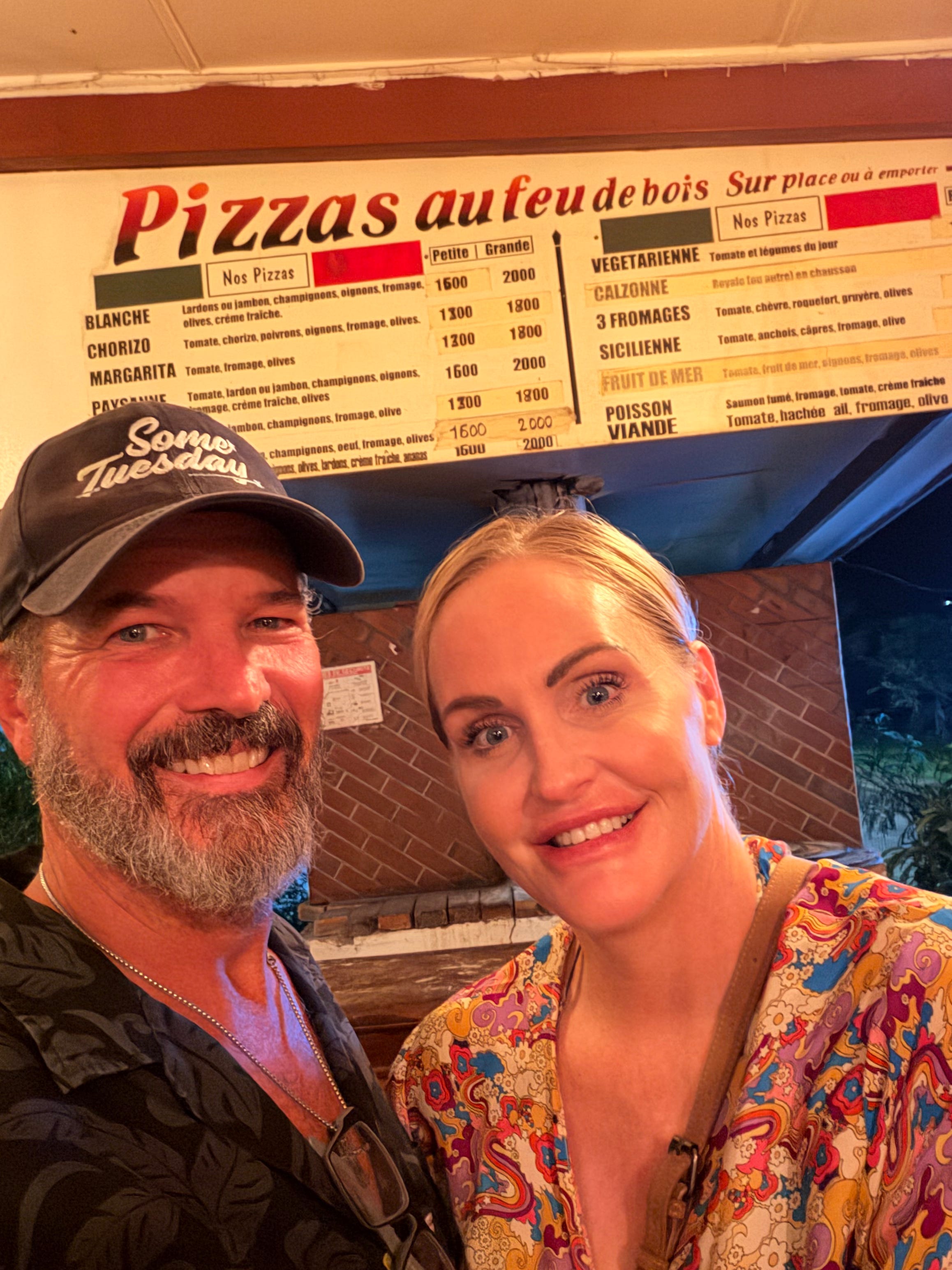
FINALLY, on the next-to-last day, we got a good restaurant meal. Brick-oven pizza, which was actually very good. Still, we had had it with Taiohae. Uncomfortable anchorage, no good restaurants, etc. Luckily the provisioning was OK, but still lacking in the fresh veggies Meghan craved. This is a required stop to clear into the country, and the only good place to re-provision and re-fuel, but once that job is done, there’s no reason to stick around.
Refueling was also, um, interesting. We had to wait an extra day because the fuel dock is also the commercial ship dock, and there was a freighter tied up on May 4, the day we planned to fuel up and leave. So, we delayed a day to May 5. I recruited a new friend, Nick on Malilia, since the fueling procedure required “med mooring” and it was recommended that you have a crew member that can throw a line 20 feet. Given Meghan’s back surgery, that wasn’t an option, so I made a friend! (He and Fran were delightful, all the way around!)
Med mooring is when you drop your anchor in the harbor and go astern (back up) to the dock until you’re within 15-20 feet of it. Then you throw dock lines to the attendant who ties them to the bollards on each side. That results in three holding points, the anchor and two stern lines. But there are a lot of things that can go wrong if this doesn’t go smoothly, especially if the current is running or wind is up.
Once the lines are fast, you throw a heaving line to the attendant, who then ties your line to the fuel nozzle. As he holds the hose, you pull the nozzle back to you, across the 15 foot gap over open water, and onto your boat. The nozzle is not an automatic shut-off, so it’s critical to monitor it closely while the tanks fill. I was a second too slow with the shut off valve, and spit some diesel into the sea on the first tank. Very frustrating, but hard to avoid given the clunky mechanism!
Oh, and I nearly forgot to mention: we arrived at the dock about 10 minutes after a super yacht had just tied up. I radio’d the captain and asked him how long he thought he’d take, and he said he needed 5,000 gallons so it was going to be a while. What are you going to do? If you get frustrated by stuff like this, well, this isn’t the life for you. We dropped the anchor and waited. After arriving at the dock at 7:30, the clock nearly at noon by the time diesel started flowing into our tanks. Just another day in paradise!!
But at last, we were ready to get out of Taiohae. I hate to sound negative in this article, we’re in paradise, right? Sorry - we really didn’t like it here and knew the Marquesas had more to offer. Just get what you need and go, as quickly as you can!
Daniel’s Bay, May 5 - May 9, 2026
And, here’s the proof! Daniel’s Bay is absolutely gorgeous. Fun Fact, this is where Survivor: Marquesas was filmed in 2001. The highest waterfall in the Marquesas is also here, but it requires a 3-4 hour hike that we weren’t interested in doing.
But, the water was beautiful and very flat. We arrived to find 5 or 6 other boats already on anchor, and we happily motored right past them all, taking a spot close to the beach in about 12 feet of water.
It’s utterly wild and untamed here. We took our paddle boards ashore and enjoyed several very peaceful, restful days to recover and recuperate. Remember, Meghan is still recovering from spine surgery and I had injured both my elbow and sustained a big hematoma on my hip during the passage. We were banged up and needed rest!
And finally, we were getting it. I was running the generator more than I’d like to, but now we had full diesel tanks and it didn’t cause stress. That meant air conditioning most nights, at least at the beginning of the evening. That helps a lot, since knocking out the heat of the day is key and the cabin usually stays reasonably comfortable overnight.
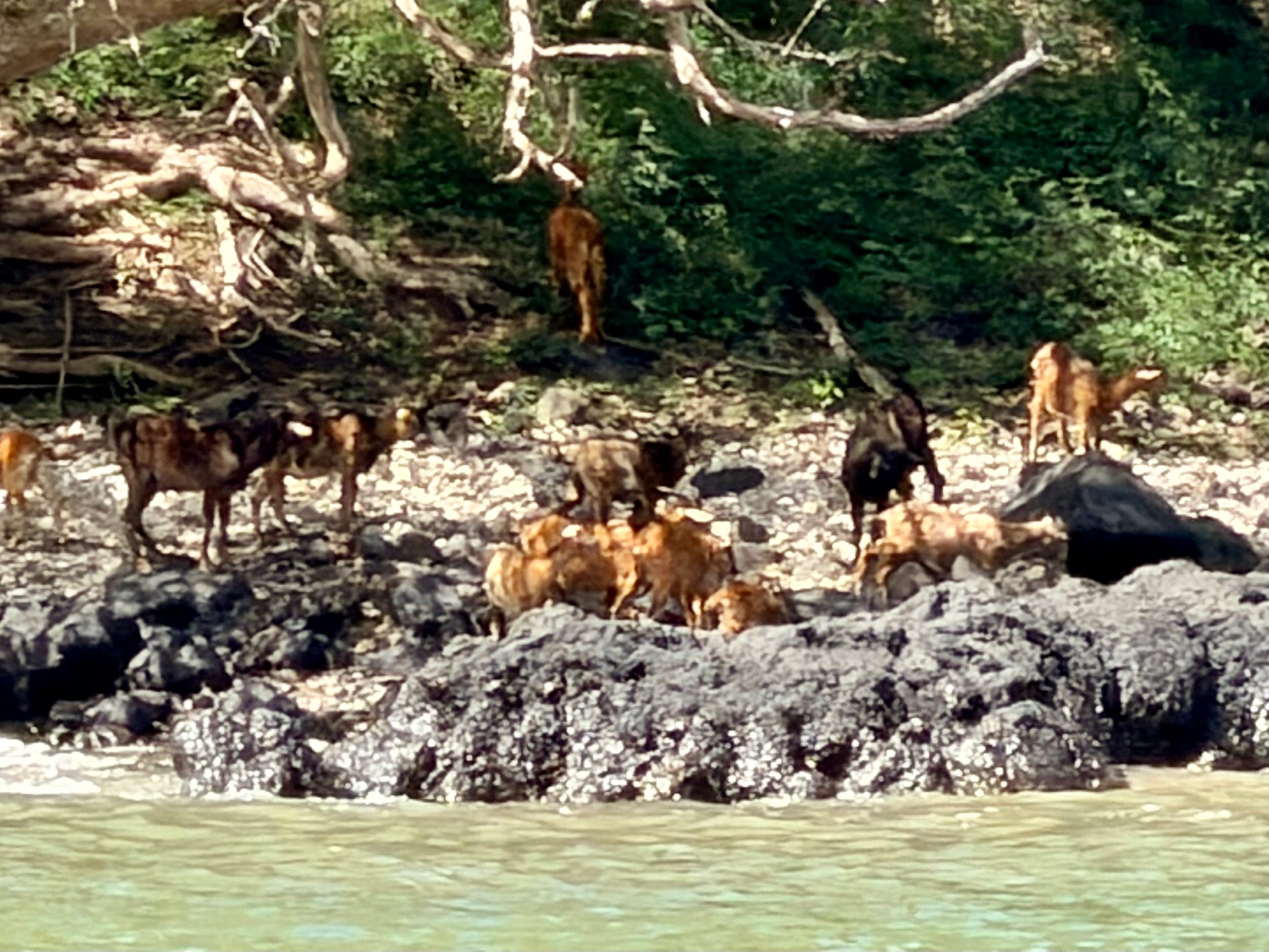
Daniel’s Bay has wild goats! Quite a few and we heard them, along with roosters crowing every single day. One morning, there were more than 10 goats down by the waters edge, and I got a good look at them from where we were anchored.
The scenery here was stunning, and exactly what we expected from the Marquesas. We got lots of rest, the rain mostly held off, and we had our batteries recharged!
We also ate like kings again, since we were freshly provisioned and Meghan is an amazing cook. I really don’t understand where she comes up with the dishes she creates half the time, because they’re truly incredible. And assembled from the larder of a working sailboat. It’s impressive and I’m a lucky man to have her along. And NO, not just for the food!!!
Every day, two different tour boats come in loaded with 6-8 tourists each, and anchor just off the beach. They let their passengers off to enjoy the beach for the day, then load up again before sunset and take off. We watched this daily ritual each day, and felt lucky to be anchored here on our own boat! We took our paddleboards ashore and enjoyed the beach for a while, then paddled around the bay. It was heaven.
There was one fellow that lived on shore, with a small house just off the beach. He was heavily tatood and had a huge nose ring, so he looked intimidating! But he was friendly and gave us a wave. Meghan joked that he might be one of those cannibals we had heard so much about, but he didn’t offer us anything other than a friendly wave!
As has become our tradition, we live-streamed a harbor tour from the dinghy. I figured out how to rig up the Starlink Mini into the dinghy, so we have full Internet to support live-streaming, and people really seem to enjoy it. We often chat with other cruisers, show off the natural features, and share what it’s like to live this sailing life!
Anaho Bay, May 9 - May 12, 2026
This was our most beautiful anchorage yet, found at the northeast corner of the island, behind a long point that extends out and gives a lot of protection from the SE current and swell. Uniquely, it has a fringe coral reef around the bag, which is very unusual in the Marquesas. Because of this, it’s important to anchor in deeper water to protect the reef.
We anchored in 50 feet of water, and I deployed 320 feet of anchor chain. That was the first time I had ever used all of my chain (300 feet) and deployed some of the rode (rope) behind it (200 feet). But it sure was good to exercise my ground tackle and know I had a lot of holding power if needed!
We were the ninth boat in the anchorage, and there wasn’t much turnover while we were there. People like it here, and tend to stick around a while! The water is turquoise blue, although not as clear as we expect in the Tuamotus. The shoreline is raw and craggy and there are a few homes and a Christian church on shore. The church is beautiful and sits on immaculately manicured grounds, that show great love and care.
We went ashore and walked up and down what we began calling “Main Street” - a footpath that runs from the single restaurant (requires reservations a day in advance, so she knows how much food to prepare!) all the way past the church. It was such a pleasant walk along the shore, enjoying the wildlife, fish jumping across the water, crabs scampering on the rocks, etc. It’s so lush and green and just… smells clean!
Meghan was walking ahead of me, collecting seashells and exclaiming over and over “It’s just so beautiful.” She was absolutely taken with the place, in a way I hadn’t seen in her before. It warmed my heart.
We passed another couple, European, and said hello. They didn’t speak English and we didn’t even know what language of theirs that we didn’t speak, so we settled for a friendly wave and a smile! Not far behind him, was a local guy collecting something in large burlap sacs that were slung over his horse. It wasn’t coffee, but he seemed like a real-life Juan Valdez!
The only way to go ashore here is to take your dinghy through the single cut in the reef. Any other location and you would wreck your boat on the coral reef, but this one cut is marked by the locals with buoys so the channel is clear. Once you’ve motored into about 18 inches of water, you throw out an anchor, climb out and walk ashore. There is no way to get to the beach without wading in thigh-high water. And that’s just fine!
We spent a lot of time touring around in the dinghy, getting as close to the wild, untouched beaches as we dared, before the coral became a risk. I went for a swim. And we did a lot of relaxing.
We did a harbor tour, of course, and I’m getting better both at flying the drone and narrating the video. The harbor tour is my best yet, and sure to keep getting better. We’ll continue to share these beautiful, exotic locations with you. Thanks for joining us on our journey!!