Days 174 - 187 (May 25 - June 7, 2026) of our five-year circumnavigation
Five atolls visited in the Tuamotus (Raroia, Makemo, Fakarava, Apataki, Rangiroa). This entry covers Makemo, Fakarava & Apataki.
351 nautical miles sailed to reach Apataki
7,613 total nm sailed since our departure from Los Angeles on December 3, 2025
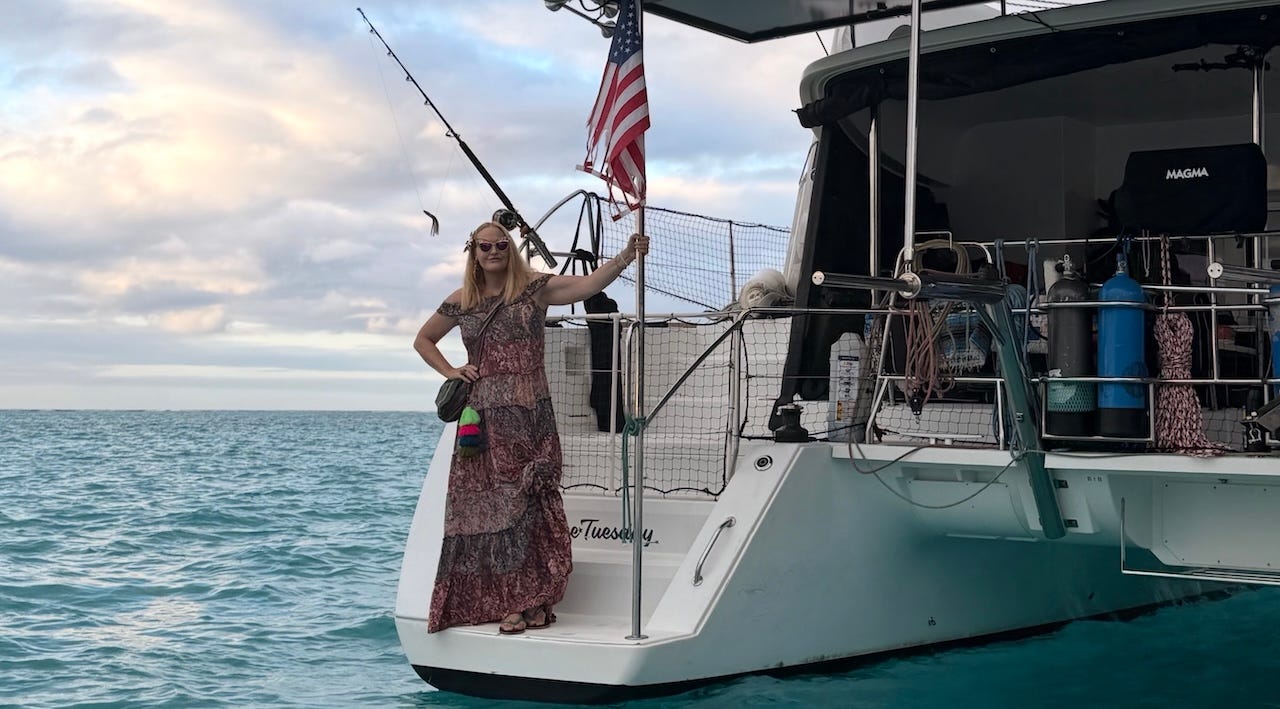
First, I must apologize for taking over six weeks to publish my next log entry! We are retired and enjoying the trip, and sometimes sitting down to write just feels like work. But once I open the laptop and the words start flowing, I enjoy it. And I know my grandkids will enjoy reading this stuff after I’m dead, so…. Here we go!
My last entry from June 2 covered the passage from the Marquesas Islands and the visit to Raroia. This entry will cover the next three atolls we visited. The Tuamotu Archipelago is one of the most unique places on earth and is what most people picture when they think “South Pacific.” For an introduction to the Tuamotus and its atolls, I suggest going back to read the previous entry if you haven’t already.
As we closed that entry, we had just departed Raroia and were on our way to Makemo. We arrived early in the morning on May 25, and motored through the wide and deep pass into the lagoon without incident. Makemo has a large public concrete dock, and provided the supply ship is not in town, cruisers are allowed to tie up for free. We decided it would be nice to be able to just step off the boat onto a dock for the first time since April, and headed for the dock.
The water looked very shallow, and there were two other catamarans already tied onto the dock. I shouted to the skipper on one of them, asking if he knew the depth farther forward. He told me he had a 1.5 meter draft (same as mine - this is the depth your boat reaches under the water) so we both figured I should be fine. I lined up and brought her alongside easily, and Meghan tossed him a line. He was French, so the language barrier caused some confusion as we made the lines fast, but soon enough we were tied up.
The dock uses large, loose steel rings that are cemented in with another piece of hardware that looks like a huge staple and allows them to move. They work fine, but it sure makes you appreciate the cleats found on docks at home. A cleat just requires a quick and easy cleat hitch, but rings require knot-tying. And as it turned out, my new French friend wasn’t very good at that, which caused me to spend 15 minutes with a marlinspike to save my expensive dock line by untying his not-quite-a-bowline granny knot. Ah well, he was friendly and helpful, so I won’t complain!
Stepping off directly onto a dock felt luxurious. We took a stroll into town and brought our trash looking for a place to dispose of it. Disposing of trash is one of those things you don’t really think about until you can no longer take it for granted! At every new port, we have to find somewhere to throw away our trash - sometimes it’s easy, today it was not. We found totally-full bins just past the end of the dock, but thought it would be rude to throw our bags on the already-overflowing and stinking pile. So, we wheeled them (in our folding wagon - one of the handiest things we own on board) about half a mile to the small “magasin” or grocery store. They were nice enough to let us use their dumpster, which was also quite full.
While Meghan went into the store and found the not-so-great selection that we would come to expect in the Tuamotus, I walked next door to the pizza restaurant - one of only two restaurants on the island. Just inside the door was a fat, shirtless Polynesian man, covered in tattoos. He spoke no English, but could see we wanted to eat. “Closed today, open tomorrow!” The other restaurant was owned by the same family, and was also closed.
Meghan picked up a few supplies from the sparse selection of prepared foods and we headed back to the boat. Before we left, I asked the shopkeeper if there was anywhere to get lunch on the island. She looked at me like it was a silly question. “Not today. Tomorrow!” Oh, OK. I’m SO lucky that Meghan is an amazing cook and we eat better on board than any restaurant in French Polynesia.
Makemo has one grocery store, two restaurants, one hardware store and what looked like a travel agency of some kind. All of them are in the same small compound owned by this family! The grocery story closed at noon, and none of the rest of them were open. It’s a different world, folks! The hustle and entrepreneurial spirit that we Americans take for granted is not entirely unheard of in French Polynesia, but rare enough that coming across a well-run restaurant with passable food and good service would continue to be an event until we finally check out in Bora Bora at the end of July!
When we got back to the boat, we logged into the Ocean Posse weekly Zoom call for members causing the South Pacific. The knowledge sharing from that group has been worth many times the price of admission, and today would be no different.
“You’re tied to the dock in Makemo? Oh, that’s nice, said Captain Dietmar of Ocean Posse. Just beware of the rats.”
“Ummm, rats?”
“Yup, the Polynesian rat. They climb up your dock lines and board your boat. They’ll chew through your electrical wiring and get into all your food. It’s awful. Most cruisers anchor out to avoid them. But they’re nocturnal, so you’re probably fine.”
We were off the dock before sunset and anchored out in the harbor! There we decided that we would continue on to the next atoll, since Makemo was very long and full of bommies. There were no anchorages that we felt we really had to see, and our next planned stop was Fakarava - one of the top five diving locations on the planet.
The sail to Fakarava was only 105 nautical miles, so like most of these short hops, we sailed it overnight. It’s critical to arrive in daylight, and the only way to do that is to time your departure for with the goal of arriving around sunrise or shortly thereafter. An additional complication is the need to arrive at slack tide, to ensure safe passage through the pass into the lagoon (see my discussion on this topic in the previous entry). So departure planning is a complicated formula based on tides, wind speeds, and routing - all trying to produce an arrival in early daylight, around slack tide (the short window when ebb tide is switching to flood tide, or vice versa).
We timed it well and arrived at slack tide at 7am. The current in the pass was still pretty heavy (all the available info only estimates when slack tide will occur, and it’s often wrong) but we made it through with little trouble. There was a large sandbar to starboard, so I gave it plenty of respect and motored in a long circle, keeping well inside the marked channel. After making my big circle, I turned south to the designated anchorage and found a decent spot in about 40 feet of water. I prefer to anchor shallower, but it wasn’t an option.
The current was pretty high, non-stop and the anchorage was very rolly, with little protection from the southerly winds. It was a beautiful place, but not comfortable on board. But we finally had a decent restaurant meal! Food and good restaurants are just not a priority, apparently, in this country, and we’re pretty sure that frites (French fries) should be named the national food of French Polynesia! They were served with pretty much every meal you’ll ever order! Fresh food? Salad? Vegetables? Don’t hold your breath!
We saw a little waterfront bar on No Foreign Land and decided to go over for a sundowner. As we approached, the dinghy got caught in the massive current - an ebb tide flowing quickly out of the pass - and I had to switch to a version of “drifting” to go with the current and get safely to the dock. It was kinda fun! Safely tied up, we found a small bar with one long picnic table and about six people enjoying cold beers. Most of them were cruisers, and one couple was staying at the guest house on the same property. We made friends with the whole group, who told us they were going to the restaurant there on the property, but sadly, reservations were required 24 hours in advance, so we couldn’t join. We jumped in the dinghy after a couple hours of merry making, and went back to the boat.
As soon as we got on board, my WhatsApp buzzed and I had a text from one of the guys we had just met: “There is so much food we can’t eat it all! Can you join us?” Twenty minutes later, we were tied to the same dock and walked into the beautiful restaurant, decorated thoughtfully with flowers and pearl floats.
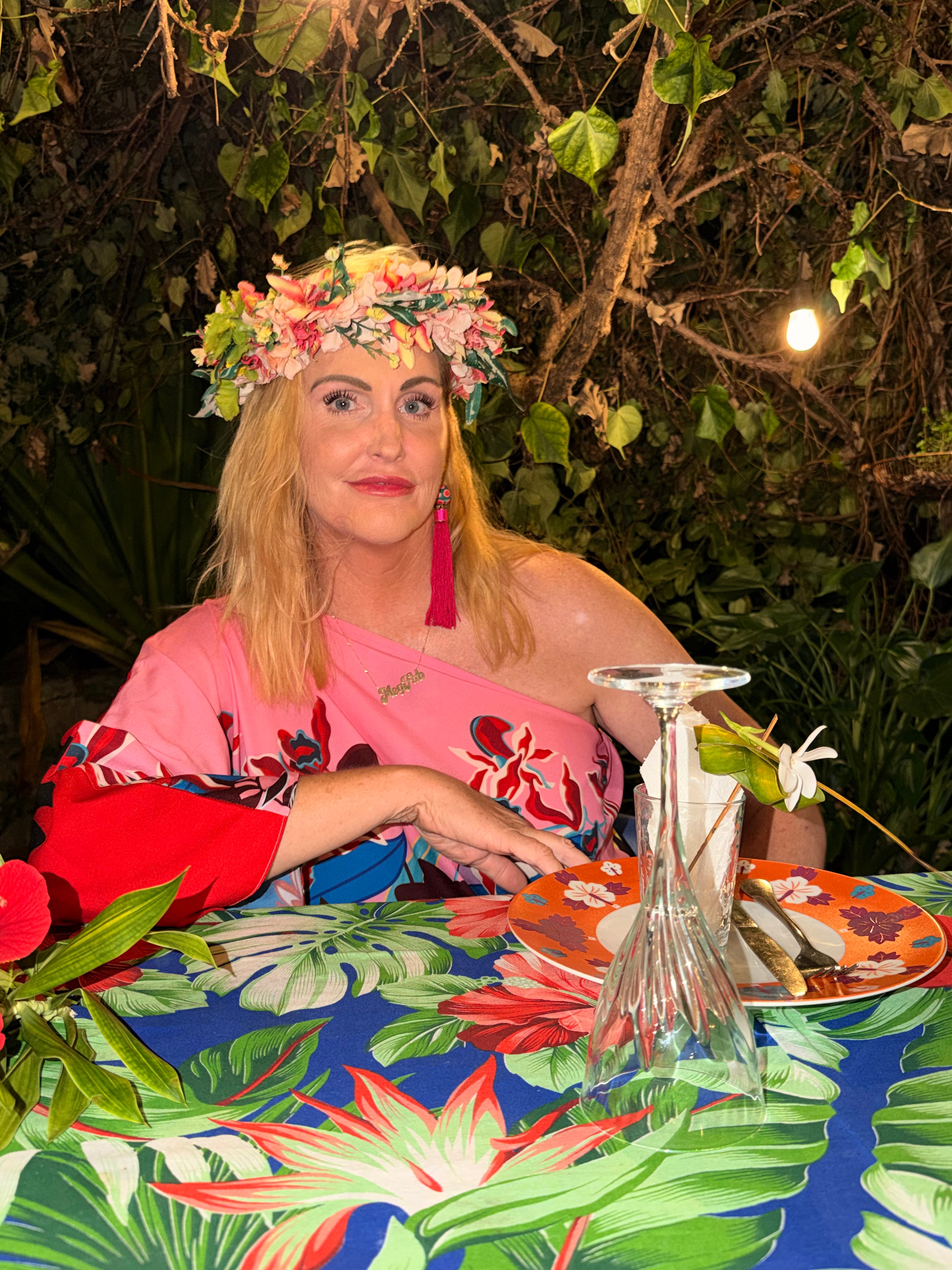
We had a great time with new friends, and the food was pretty good. True foodies would be miserable here, but we don’t mind. We enjoyed it enough to come back the next night, with just the two of us. It was date night, and Meghan looked gorgeous, as always!
The next day, it was time to go diving on the famous “wall of sharks.” I decided to do a “tethered dive” where I would stay attached to the dinghy, while Meghan drove it at the surface. I had a 100 foot anchor rode (rope) that I would hold while underwater, so I wouldn’t get separated. It was a drift dive in the same pass were we had entered the lagoon, and there was a lot of current, so it was critical to not lose the dinghy. This would enable Meghan to easily find me and pick me up, far from where I began the dive.
Drift diving is amazing because you feel like you’re flying. Just drop down to depth (60 - 90 feet in this case) and ride the current! No finning required - the current just pushes you along the underwater landscape, and in this case, past hundreds and hundreds of sharks!
The day before we left, our new friend Mitch on Shingtai had trouble raising his anchor. He was anchored directly behind us and once it was clear he needed help, I jumped in my dinghy and headed over there. He donned dive gear and dropped to the bottom with a hammer in his hand. I took the helm and helped his crew retrieve the anchor chain as he freed it. When he surfaced, he said the chain was wrapped three times around a bommie and there’s no way it would have been freed without diving.
That’s one of my favorite things about this community. People will spring to your assistance at a moments notice, and nearly all of us adopt this “pay it forward” attitude. If somebody needs help, or needs to borrow a tool, or whatever, we all do what we can to help out. It’s beautiful, really.
The day after Mitch left, we also departed to head to the north end of Fakarava. There was a town there, with small shops, more dive sites, and pearl farms! The passage was about 28 miles, all inside the lagoon of this large atoll. It was a large channel used by much larger ships, and clearly marked on the charts, so we didn’t have to worry about dodging bommies (coral heads). We made the trip in about five hours.
We struggled to anchor, dropping the hook twice and finding poor holding. The anchorage was crowded, and the anchor dragged in the soft sand, so we quickly changed plans and anchored in deeper water for the night. The next day, we motored back in and found a nice spot close to the dinghy dock.
While there, I went diving twice - but this time, I went with a professional dive company since this pass was much larger and more dangerous. I also got some advice that if I wanted to see the best stuff, a guide was crucial. I hoped for large manta rays, but didn’t see any. As before, we saw hundreds of sharks - black tips and grays mostly, but we did catch sight of a huge tiger shark in the distance. Sadly, he was too far away for good video and we were unable to catch up or find him again. He was enormous!!
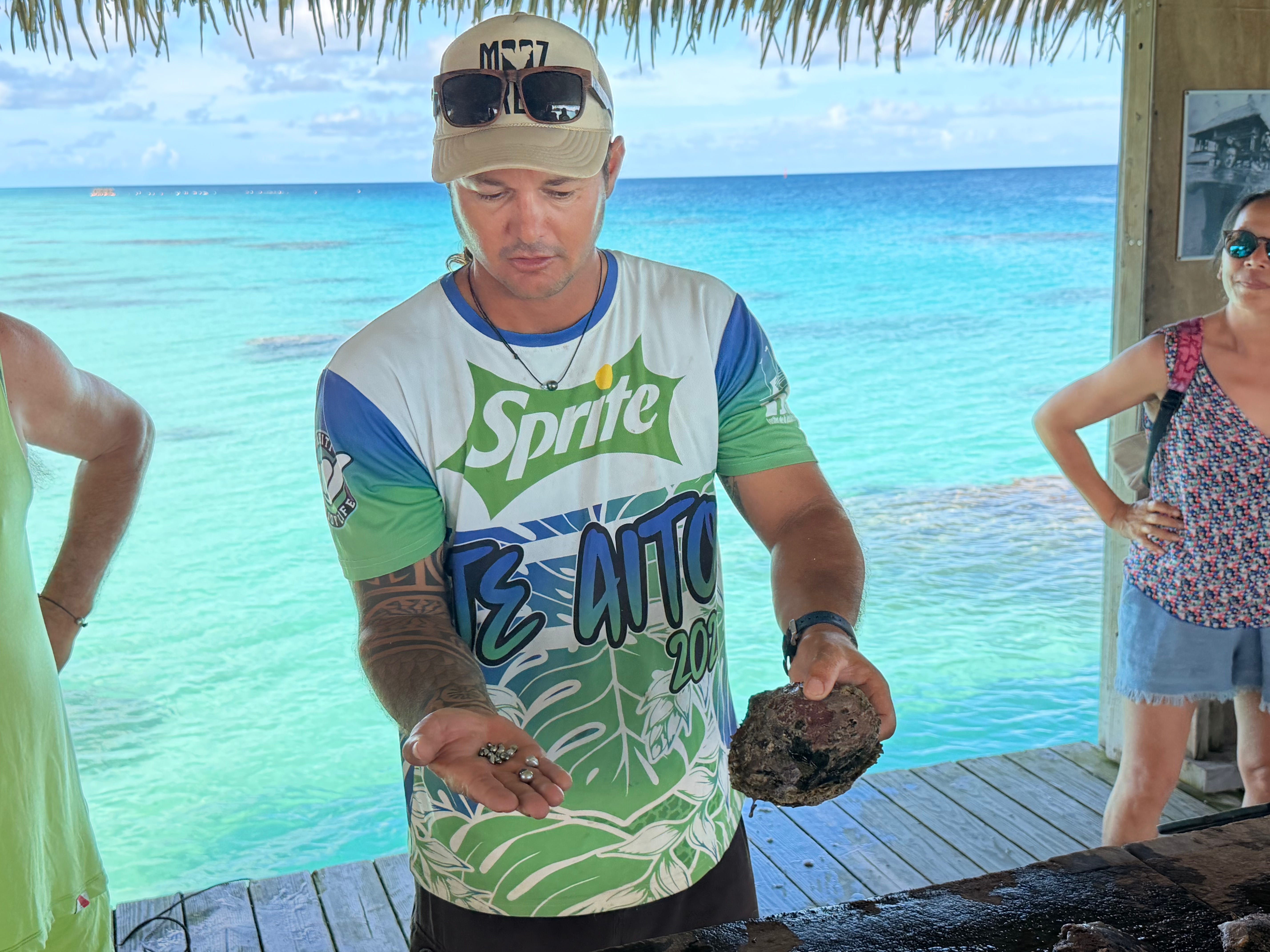
There were a handful of good restaurants, which we enjoyed and we also attended a presentation about how they farm pearls. The world-famous Tahitian black pearl is farmed here, and the presentation was pretty fascinating, explaining the process.
We discovered that the hotel near the pearl farm didn’t mind if you used their dinghy dock, provided you bought some drinks while you were there! So we had a few and Meghan met this delightful Polynesian woman who was making flower crowns down by the beach. Meghan approached her and asked how much she would charge for a flower crown, and she just smiled, pointed at her beer, and said “Another one of these!” Meghan, incredulous, confirmed, “If I buy you a beer, you’ll make me one?”
“Oui, oui!"
We watched her pick the flowers and weave them into this beautiful work of art. She was sitting at a small picnic table by the water’s edge with a friend, another woman who was playing guitar. Both of them sang together as she weaved the flowers together. It was truly quite surreal!
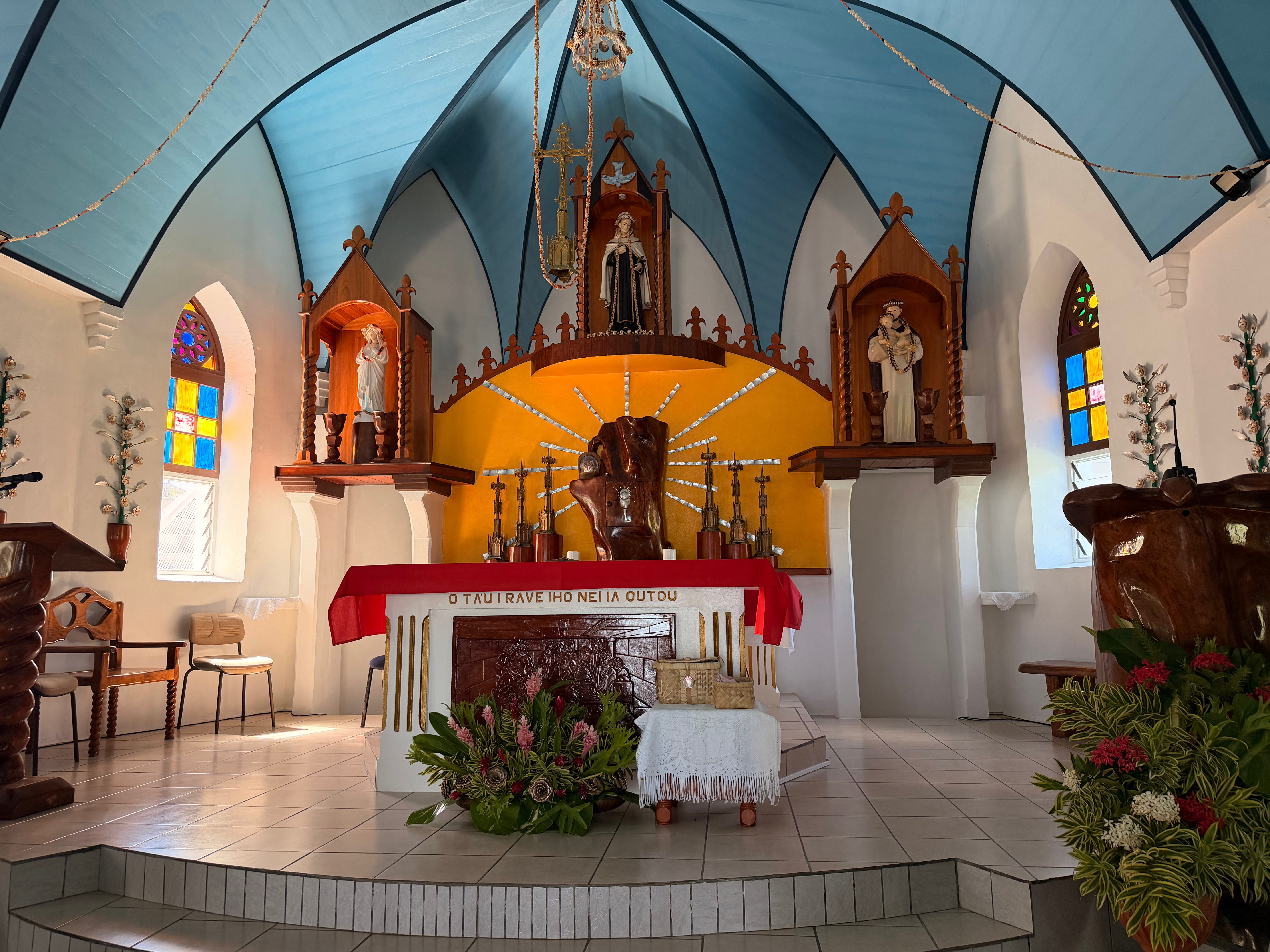
I continued our tradition of stopping into any church that is open to take a moment to pray, talk with God, and express our extraordinary gratitude to Him for being able to live this life and this adventure. Fakarava had one of the most perfect, beautiful little island churches I’d ever seen. It was decorated in intricate shell chandeliers and handwork hanging from the ceiling. Be sure to zoom in on the photos below to see the details!
After an incredible week-and-a-half in Fakarava, it was time to move on. Our next stop would be Apataki, a much smaller atoll, about 15 miles long and much more remote. Fakarava has an international airport and is one of the more developed atolls. Apataki has a small village. We arrived early in the morning on June 6, and found about three knots of current against us in the pass. Some Tuesday easily overpowered that and we motored safely into the lagoon.
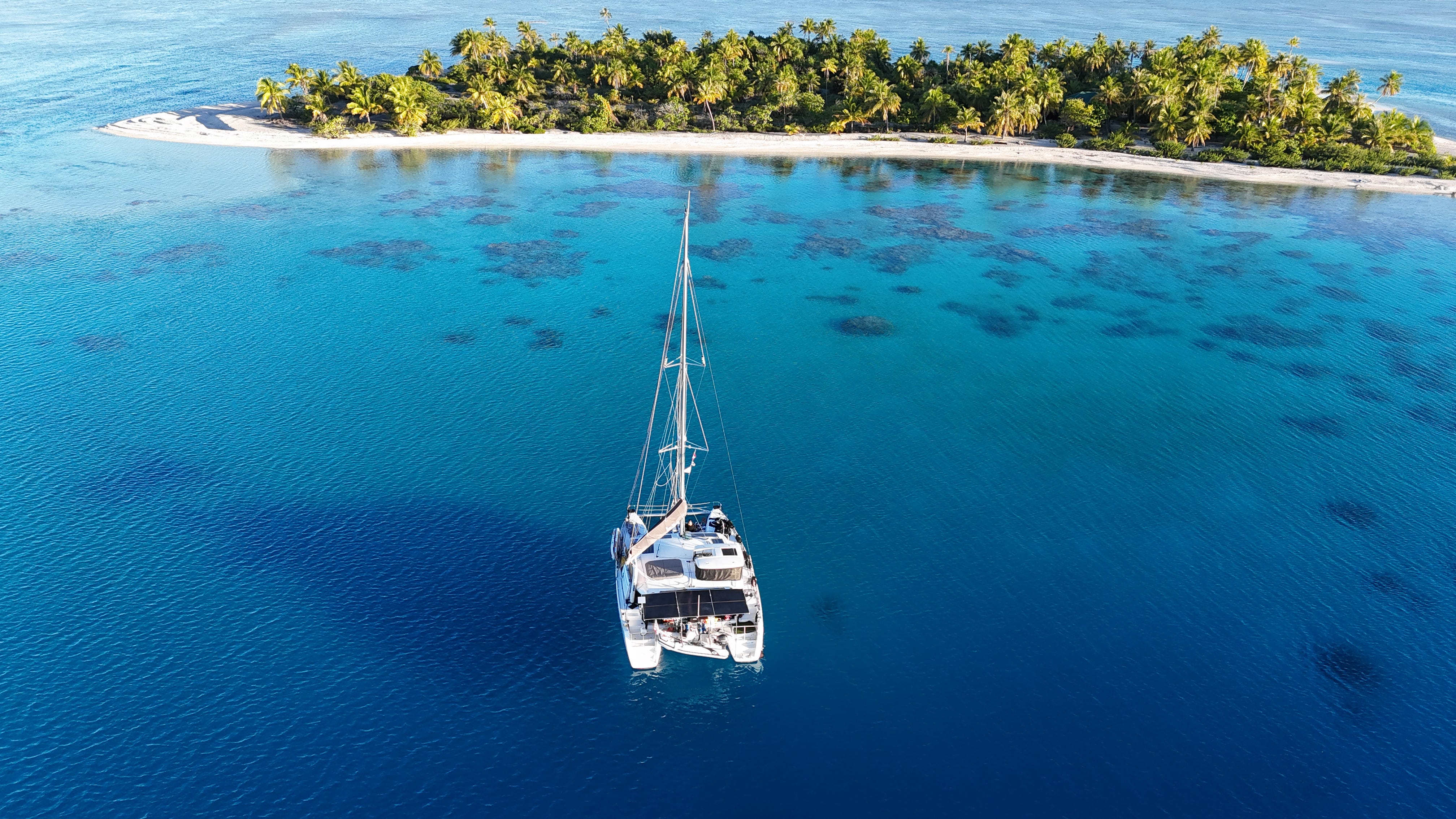
We turned South and headed for a tiny little motu that looked promising on the charts. We had to be careful and watch for bommies as we cross the lagoon, but it much much more clear than Raroia had been. Soon enough, we arrived at Motu Run Vahine and had the entire place to ourselves. No other boats!!
There was a beautiful house on the motu, giving these folks their own private island. It was a gorgeous home, from what we could see. Not the usual tumble-down shack that we were used to. With all the palm trees, we couldn’t see much of it, and even though I flew the drone, I didn’t want to invade their privacy. Suffice it to say, life is good for whoever lives there!
We anchored in about 20 feet of water, in sand, just a few hundred feet from the beach. The water was so clear I could see my anchor lying on the sea floor, and could get comfortable that it had a good bite and would hold. I’ve never seen water THAT clear before or since. It was incredible.
Sadly, things took a turn for the worse when Mr. Pickles, Meghan’s 17 year-old pug suddenly became very ill. He couldn’t stand, was vomiting bile, and didn’t eat anything - even hamburger - when she offered it. He’s old and we were certain the time had come. We were prepared, but Meghan was still incredibly sad at the idea of his imminent passing.
We planned a burial at sea. We had a cloth to wrap him in, weights to ensure he would sink in a dignified way, and flowers and personal mementos ready to go. But of course, we couldn’t do a burial-at-sea inside the lagoon - we needed to be at sea where it was thousands of feet deep. So, not wanting to be trapped in the lagoon waiting for slack tide with a beloved but dead pet on board, we weighed anchor the next morning and headed for the open ocean, and then Rangiroa - the largest of the Tuamotus.
Much to our surprise, he made it. We were sure all the signs pointed to a doggie funeral, but somehow this spunky little pup pulled through! Now, Meghan has taking to making him special meals with real chicken since he stopped eating his dog food. So our running joke is now that he faked his death to get better food!
As I write this, it’s been nearly six weeks and he’s still alive and kicking! Meghan has been very grateful for the extra time she’s been given with her precious “ride or die.” But she’s mentally prepared and we’re at that stage where every time we get back to the boat, the first thing we do is check if he’s still breathing. So far go good, Mr. Pickles!! We salute you!
As we exited the Apataki pass to the open ocean, we didn’t know if Pickles would live or die so I set a course for Rangiroa and figured we would make decisions as fate befell us. As it turned out, we arrived at the Rangiroa pass early on June 8 with our full crew of four! I’ll tell you all about that, and the passage to Tahiti in the next entry.